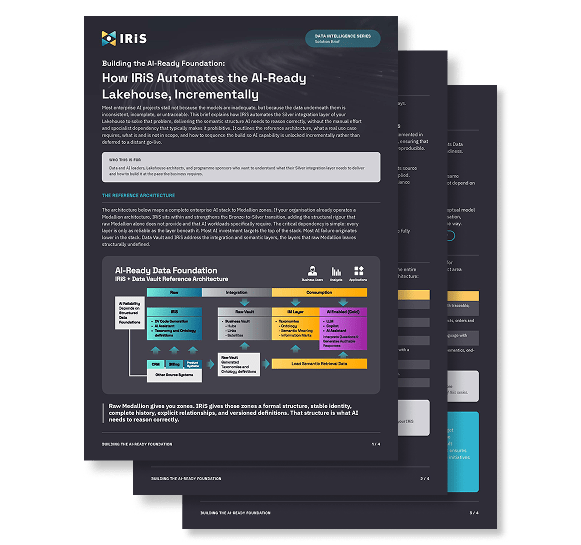
A solution brief for data and AI leaders who are ready to move from architecture to action.
The previous articles in this series have made the case that enterprise AI succeeds or fails at the data layer, not the model layer. That stable entity identity, complete temporal history, explicit relationships, and versioned business definitions are not implementation details; they are the structural prerequisites for AI you can trust. And that the Silver integration layer of your Lakehouse is where those properties either get built in or get left out.
This article is where architecture meets execution.
The question most readers reach at this point is a practical one: what does it actually take to build this foundation? What is genuinely in scope for Phase 1, and what comes after? How long does it take? And what does IRiS specifically automate, and what does it not?
We have written those answers up as a concise solution brief, which you can download below.
What the Brief Covers
The brief maps a complete enterprise AI stack to the Medallion zones most organisations already operate. It shows precisely where IRiS sits within that architecture, what it delivers, and what belongs to the layers above it.
It covers a concrete use case in full: a financial services organisation building AI for customer churn prediction. Five foundational data capabilities are required. Each is explained structurally, with the specific Data Vault construct that delivers it, so the connection between methodology and AI outcome is explicit rather than theoretical.
It also sets honest expectations. IRiS automates the integration and semantic foundation. It is not the complete AI stack. RAG pipelines, LLM interfaces, and ML platforms sit in the next layer. The brief maps all of this clearly, including a phased roadmap that shows how AI capability unlocks incrementally from the first sprint rather than at the end of a multi-year build.
The closing investment case makes a point worth stating plainly: organisations that are making enterprise AI work got the integration layer right first, then reused that investment across every subsequent use case. Those that skipped it often built twice.
Who This Is For
Data and AI leaders, Lakehouse architects, and programme sponsors who are actively evaluating how to scope and sequence a Silver layer build, and want a reference document that explains the architecture, the automation, and the delivery approach in one place.
If you have followed this series from the beginning, this brief is the "ready to scope this?" document. If this is your first encounter with the series, it is a self-contained entry point.