Discover the best Data Vault automation software for modern data platforms - Learn more


Ignition | 13 March 2026

Most enterprise AI projects stall not because the models are inadequate, but because the data underneath them is inconsistent, incomplete, or untraceable.
This brief explains how Data Vault 2 and IRiS solve that problem. It outlines the reference architecture, what a real use case requires, what is and is not in scope, and how to sequence the build so AI capability is unlocked incrementally rather than deferred to a distant go-live.
WHO THIS IS FOR: Data leaders, architecture teams, and AI programme sponsors who want to understand the data foundation investment required to make enterprise AI work reliably.
The architecture below maps a complete enterprise AI stack to both Medallion zones and Data Vault components.
If your organisation already operates a Medallion architecture, Data Vault sits within and strengthens the Bronze-to-Silver transition — adding the structural rigour that raw Medallion alone does not provide.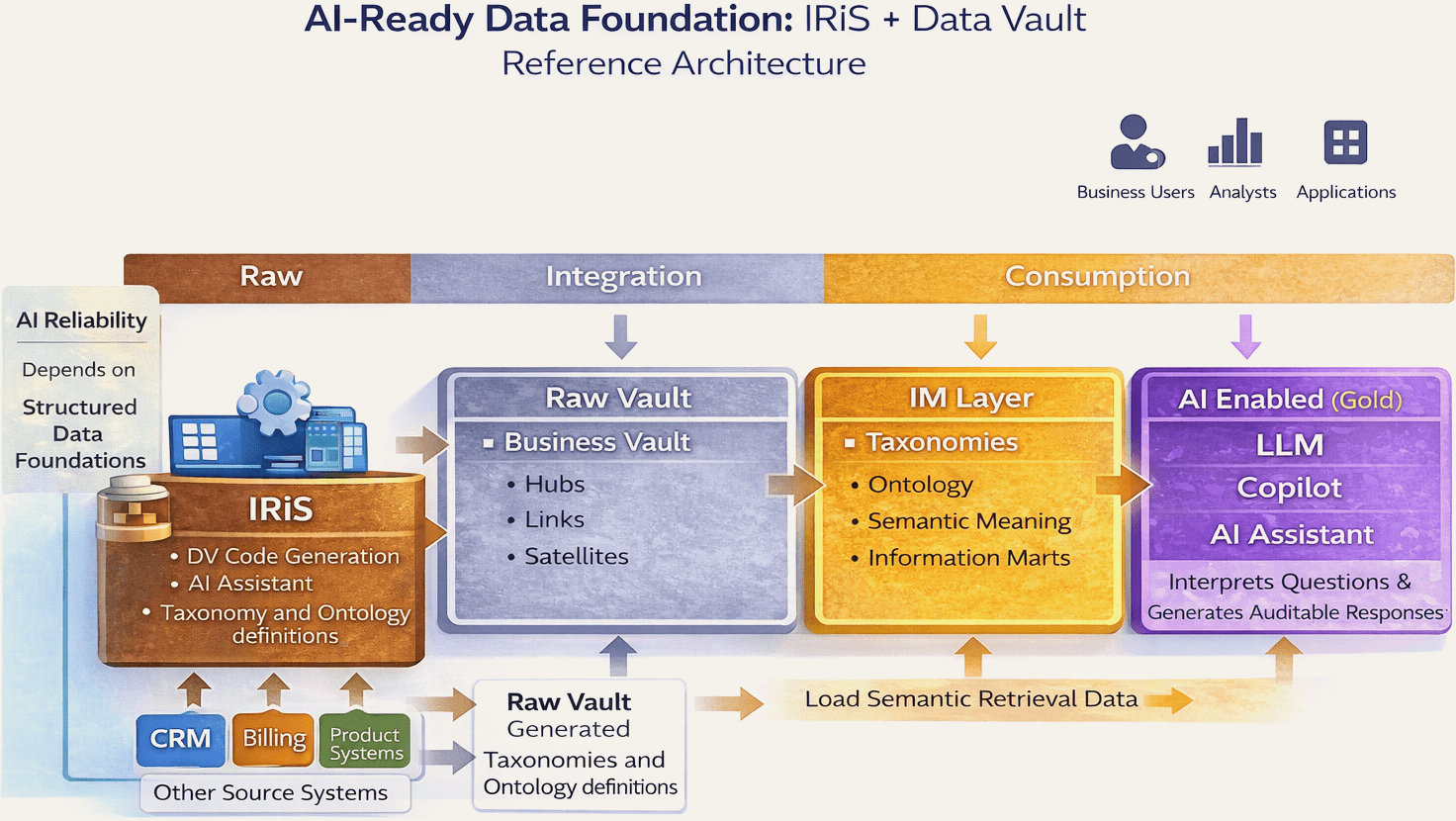
The critical dependency is simple: every layer is only as reliable as the layer beneath it.
Most AI investment targets the top of the stack.
Most AI failure originates lower in the stack.
Data Vault and IRiS address the integration and semantic layers — the layers that raw Medallion leaves structurally undefined
Raw Medallion gives you zones.
Data Vault gives those zones a formal structure — stable identity, complete history, explicit relationships, and versioned definitions.
That structure is what AI needs to reason correctly.
A Concrete Use Case: Customer Churn Prediction
Consider a financial services organisation that wants AI to identify customers at risk of churning within the next 90 days.
The AI model requires five foundational capabilities. Each maps directly to a Data Vault structural property:
Consistent customer identity
Customer records across CRM, billing, and product systems are resolved through Hub business keys, creating one stable entity per customer.
Long-term behavioural history
Twenty-four months of behaviour is preserved in full through Satellites, timestamped and never overwritten.
Cross-entity relationship context
Relationships such as products held, complaints raised, and campaigns responded to are explicitly encoded in Links, rather than inferred through joins.
Consistent business definitions
A single definition of “churned” is implemented in the Business Vault as a versioned rule, ensuring that training labels remain consistent and reproducible.
Auditability
Every prediction input is traceable to its source system and the Business Vault rule applied. In regulated industries, this is a compliance requirement, not a nice-to-have.
Without these properties:
Models train on inconsistent labels
Historical context is incomplete
Outputs cannot be fully explained
The result may look plausible during testing — but it will not survive operational or regulatory scrutiny.
Data Vault and IRiS deliver the integration and semantic foundation.
They are the foundation of the AI stack — not the entire stack itself.
The table below clarifies what is included in the foundation and what belongs to later layers of the AI architecture:
|
Capability |
DV + IRiS? |
What delivers it? |
|
Stable entity identity across sources |
✓ Included |
Hub Business Keys |
|
Complete temporal history |
✓ Included |
Satellites |
|
Explicit relationship structure |
✓ Included |
Links |
|
Versioned business definitions |
✓ Included |
Business Vault rules |
|
End-to-end data lineage |
✓ Included |
DV structural audit trail |
|
Natural language query interface |
✗ Not included |
LLM / Copilot layer (built on top of an Infomation Mart asset with a Semantic Model) |
|
Retrieval / RAG pipeline |
✗ Not included |
RAG engine (scoped separately) |
|
Business consumption dashboards |
✗ Not included |
Information Marts & reporting layer — Power BI, Tableau, etc. |
|
ML model training and inference |
✗ Not included |
ML platform — Azure ML, Databricks MLflow, etc. |
HONEST EXPECTATION: After Phase 1, you will have built the foundation the AI needs — not the complete AI product.
Capabilities such as RAG pipelines and LLM interfaces sit in the next layer of the architecture. These can be scoped either alongside the foundation or immediately afterwards with your IRiS implementation partner.
Data Vault 2 is the methodology.
IRiS is the automation platform that makes implementing it fast, consistent, and accessible to teams without deep Data Vault specialisation.
4.5× faster delivery with 65% less engineering effort
Automation removes repetitive engineering tasks so teams can focus on business logic.
Single-source incremental delivery
IRiS generates one source table at a time, allowing AI capability to begin unlocking from the first sprint rather than after a multi-year build.
Consistent semantic integrity
Every generated artefact follows the same structural conventions. Quality does not depend on individual engineer discipline.
IRiS AI Assistant
The assistant guides teams from conceptual model to Data Vault design in a single conversation, capturing business definitions along the way.
The IRiS AI Assistant is available now.
The most effective approach is to build the foundation for the highest-priority subject area first, unlock AI capability for that domain, and then expand incrementally.
A typical Phase 1 timeline with IRiS is four to eight weeks for one subject area across two to three source systems.
|
# |
Focus |
Deliverable |
AI Capability Unlocked |
|
1 |
Foundation — first subject area |
Raw Vault + Business Vault, core DQ and definition rules |
AI can answer questions on this subject area with traceable, consistent results |
|
2 |
Expand — additional sources |
Further Hubs, Links, Satellites as business priorities drive scope |
Cross-entity AI reasoning — customers and products, orders and suppliers |
|
3 |
AI Stack — retrieval and interface |
RAG pipeline from Business Vault to LLM; consumption layer |
Business users query the platform in natural language with auditable responses |
|
4 |
Scale — full platform + advanced AI |
Complete semantic model; ML model integration |
Enterprise-wide AI with full history, consistent semantics, end-to-end auditability |
PHASE 1 SCOPE: 2–3 source systems. One core subject area (e.g. Customer, or Customer + Product). Raw Vault generated via IRiS. Business Vault with core definitions and DQ rules for quality visibility. Timeline: 4–8 weeks.
Note – DQ management will be addressed in detail in a future article of this series.
Building the AI stack before the foundation often means building twice:
First to get something running
Then again to make it trustworthy
Organisations that are succeeding with enterprise AI built the semantic foundation first. They now reuse that investment across every new subject area and use case.
Data Vault provides the foundation.
IRiS makes building it achievable in weeks.
An experienced IRiS implementation partner ensures that the methodology, automation platform, and AI stack operate as a coherent programme, rather than separate initiatives that must later be reconciled.
With IRiS, you can do both.
IRiS is a Data Vault 2 automation platform available on the Microsoft Azure Marketplace, supporting Microsoft Fabric, Snowflake, and Databricks.
The IRiS AI Assistant is available now.
IRiS is implemented by a global network of authorised partners with deep Data Vault and AI stack expertise.
This article is part of the Data Vault Intelligence Series.