Discover the best Data Vault automation software for modern data platforms - Learn more


Ignition | 18 August 2026

Put three capable data engineers in a room with the same source table and ask them to model it. You will often get three different answers. One will treat the account number as the business key. One will argue it is a composite. One will point out that the same customer appears in two systems under different identifiers and ask what you want to do about that.
None of them are wrong, exactly. That is the problem.
Modelling decisions like these get made hundreds of times over the life of a data platform, usually under delivery pressure, usually by whoever is closest to the work that sprint. Individually they look small. Collectively they determine whether the platform holds together in two years or quietly turns into something nobody wants to touch.
Certification is normally sold as a credential for an individual: a line on a CV, a badge on a profile. That undersells it. The more interesting effect is what happens to a team once enough of them share the same training.
The arguments get shorter. A shared vocabulary means the debate about the business key stops being a matter of opinion and starts being a matter of applying a standard. Teams that have been through certification together spend less time relitigating decisions that the methodology already has a position on, and more time on the genuinely ambiguous cases that deserve the discussion.
Standards outlive the people who set them. Most data platforms are built by a rotating cast: permanent staff, contractors, an implementation partner, then a different implementation partner. When conventions live in one architect’s head, they leave when that architect does. When they live in a methodology the whole team has been trained in, a new starter can read the existing model and understand why it looks the way it does without an archaeology exercise.
Rework at integration drops. The expensive failures are rarely visible in the sprint that causes them. They surface later, when two subject areas built by two different squads need to join and the entity resolution does not line up. Consistent modelling upfront is unglamorous work that mostly announces itself through the absence of a crisis six months later.
Onboarding gets faster. If your partners and contractors hold the same certification, you are not spending the first fortnight of every engagement negotiating conventions. As one of our clients at Central Queensland University put it, with Data Vault “teams spend less time writing code for repeatable processes.” The same logic applies to the time spent agreeing on how to do things.
Training the engineers is the obvious move. Training the people who fund the work is the one most organisation skip, and it is usually the more expensive omission.
A modelling approach that separates business keys, relationships, and descriptive history produces a structure that looks unfamiliar to anyone expecting a conventional star schema. If the executive sponsor has never had that explained, the first status meeting where someone shows the model tends to go badly. The questions come out as “why are there so many tables” and “why is this taking longer than the last one,” and the delivery team ends up defending the architecture instead of discussing the outcome.
An hour of executive enablement is not about turning sponsors into modellers. It is about making sure the person approving the budget understands what they are approving and why the structure earns its keep when the source systems change. That conversation is much cheaper to have before the build than during it.
If you are assessing training options, three things matter more than the syllabus:
Since 2017 we have trained more than 1,000 professionals across Australia, New Zealand, Singapore and India. The pattern in the teams that get the most out of it is consistent: they certify a critical mass rather than a single person, they include at least one person from the business side, and they brief their sponsors separately.
The teams that get the least out of it send one engineer, who returns to a team that has not changed how it works and gradually reverts to whatever the local convention was.
Certification is not the thing that makes a platform succeed. Plenty of certified teams have shipped disappointing platforms. But it removes a whole category of avoidable failure, the kind where the architecture was sound and the delivery was competent and the thing still came apart because five people were quietly working to four different standards.
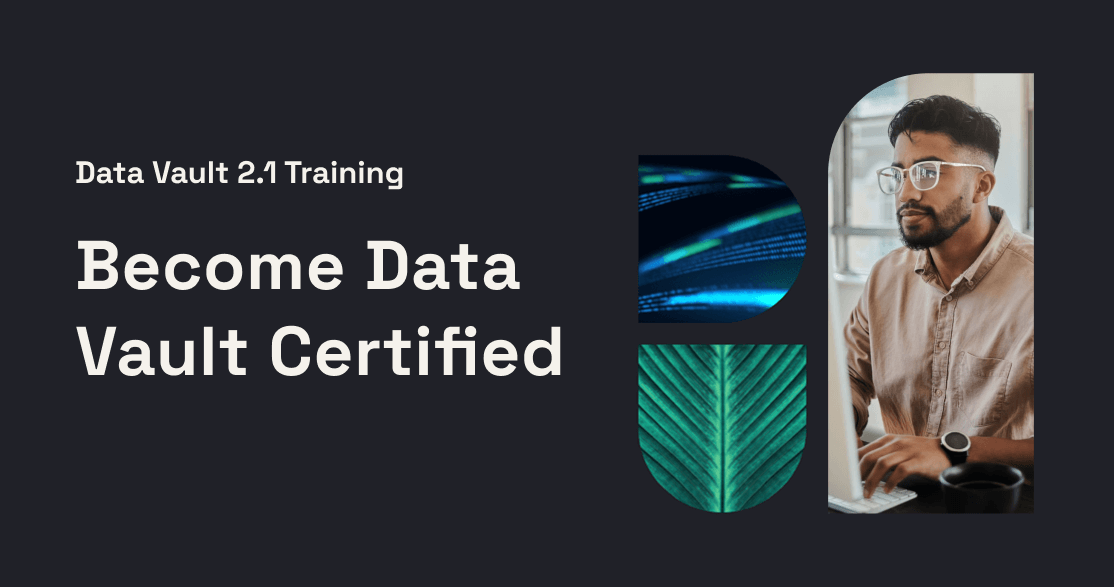
Our next Data Vault 2.1 certification course runs 15 to 18 September 2026, delivered live and online by our master trainers.








.png?)